In 2023, the team that proposed that "erythritol may increase the risk of cardiovascular events" has now set its sights on xylitol. After the safety of sugar substitutes such as aspartame and erythritol has been questioned, another old natural sugar substitute, xylitol, has also become the latest protagonist under the microscope.
On June 6, 2024, a paper published in the European Heart Journal showed that xylitol, which is often regarded as a popular sugar substitute by people who are losing weight and diabetics, may be associated with an increased risk of cardiovascular events (heart disease, stroke), such as accelerated arterial plaque formation.
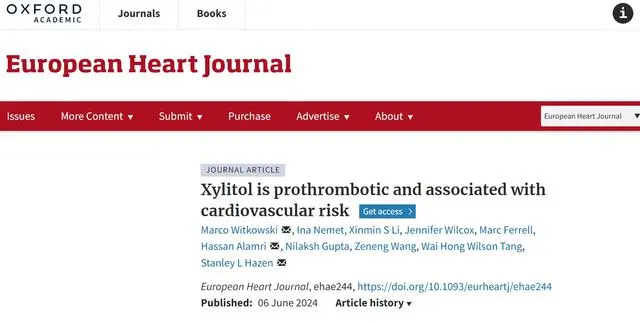
It is particularly worth mentioning that this group of researchers from Cleveland Clinic are the same group of people who triggered the big discussion of "erythritol may increase the risk of heart disease" last spring.
The goal is more direct
Compared with last year's study, which focused on finding chemicals that "induce the risk of heart disease, stroke and death" in people undergoing heart assessments, and finally targeted erythritol, this time the research object is xylitol from the beginning.
First, the researchers analyzed blood samples preserved by more than 3,000 early study participants. In the follow-up, some people had cardiovascular events such as heart attacks and strokes, and the researchers found that the xylitol levels in the blood of these people would also be higher.
The researchers also studied the effect of xylitol on coagulation. First, in the test of human whole blood and platelets, it was found that xylitol caused the platelets in the blood to coagulate. At the same time, through the damaged mouse carotid artery, the researchers also found that xylitol would accelerate the coagulation rate of plaques in the damaged artery. Once the thrombus enters the artery and vein, it may cause a heart attack, stroke, or even death in humans.
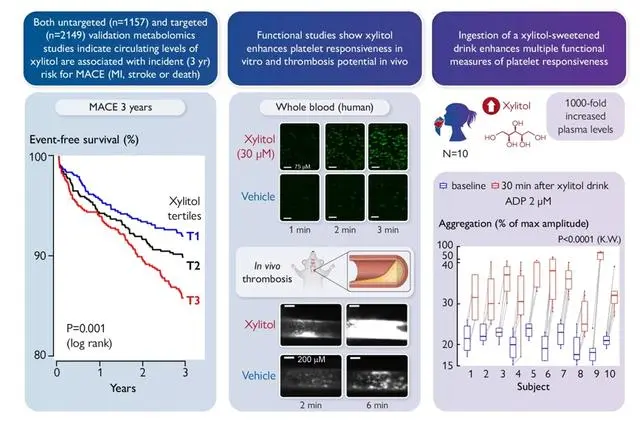
In another small controlled trial, researchers recruited 10 healthy volunteers and collected blood 30 minutes before and after drinking xylitol beverages to test blood susceptibility to coagulation. Another 10 volunteers drank glucose or other sugary sweet drinks. The study found that volunteers who drank xylitol beverages had a significant increase in blood coagulation ability, but the coagulation ability of the glucose control group did not change.
Cardiologist and lead researcher of the study Stanley Hasen told the media: "I think we have to figure out whether this is a common situation for all sugar alcohols, or just some of them. So far, the research seems to be all sugar alcohols, but everyone needs to do more research."
Hasen said: "We are trying to find the next cholesterol, another way to cause heart disease. We think erythritol and xylitol are related to heart disease, or to the development of future heart disease events."
In order to avoid public panic, researchers also emphasized that although studies have shown that xylitol is associated with an increased risk of cardiovascular events, it does not mean that xylitol will cause such events.
Unnatural use of natural compounds
This series of studies is also challenging the common understanding that xylitol and erythritol are "healthy, natural sugar substitutes." Some practitioners also emphasize that the human body also produces such substances in the process of natural metabolism.
But Hasen pointed out that an unusual situation has emerged in the past 10 to 20 years. Humans are experiencing levels of xylitol that have never been experienced in the evolutionary process. Even though these substances are natural compounds, they are being used in a very unnatural way, far higher than the level that the human body may normally experience.
The researchers also found that high xylitol levels seem to be more harmful to the heart than high cholesterol. They said that if a high-cholesterol diet is consumed, it may increase blood cholesterol levels by 10% to 30%. But if high-xylitol products are consumed, the level of chemicals in the blood can be increased by up to 1,000 times and continue to increase for 4-6 hours.
This question can also be presented in a different way: in Hasson's heart disease prevention clinic, people with cholesterol levels in the top 25% had a 30% higher risk of cardiovascular disease events compared to the bottom 25%; and those with blood xylitol levels in the top 25% had a 200% increased risk of cardiovascular disease events.
Refutation and doubt
The Calorie Control Council, which represents low-calorie beverage manufacturers and suppliers, publicly refuted this study.
Cara Sanders, president of the association, issued a statement saying that the results of this study contradicted decades of scientific evidence from global health and regulatory agencies on the safety and effectiveness of low-calorie sweeteners such as xylitol. She emphasized that xylitol, as a delicious, low-calorie sweetener, has been used with confidence for more than 60 years and has been proven to have dental health benefits, including preventing plaque and tooth decay, and is naturally present in foods such as strawberries, lettuce and oats.
Similar to last year's study on erythritol, the research methods of this experiment have also been questioned.
Rob van Dam, a professor of exercise and nutritional sciences at George Washington University, explained that the findings of this paper are striking and add to the research on the risks of artificial sweeteners. But scientists may not be able to properly test the link between consuming xylitol and heart disease risk because they used blood from people who were fasting, which means that the blood may contain xylitol metabolites produced in the body.
He questioned: "Then the question is, do these elevated xylitol levels really reflect that the dietary intake of xylitol is bad? Or does it just mean that people's metabolism is wrong, leading to elevated xylitol levels?"
The researchers also acknowledged that there may be such a problem and conducted supplementary experiments-control experiments in which volunteers drank xylitol drinks and water also showed that platelets seemed to be more likely to aggregate.
Professor Rob van Dam said that this issue may not be very worrying when viewed alone, but there is increasing evidence that some artificial sweeteners may not be as harmless as we think. Hundreds of millions of people are now exposed to this situation, and some people are even exposed to it every day, so every study that raises concerns is closely related to public health.


